
You sit through a lecture, take notes, and walk out feeling like you learned something. But a week later, most of it is gone. The problem isn't your intelligence — it's that your study process ends where it should begin. The PEARS method is a framework for turning every lecture into lasting knowledge, and it starts before you even sit down.
What Is the PEARS Method?
PEARS is a lecture-centered study framework. Instead of treating studying as something you do the night before an exam, PEARS builds retention into every stage of the learning process — from before the lecture starts to weeks after it ends.
The four stages are:
- P — Prime: Preview the material before your lecture
- E — Engage: Be fully present — record, listen, and take efficient notes
- AR — Active Recall: Test yourself on the lecture right after
- S — Spaced Repetition: Review at strategic intervals so you never forget

The key insight behind PEARS is that learning is compounding. Every concept you retain makes the next one easier to understand. But every concept you lose means you're rebuilding from scratch. PEARS is designed to keep that compounding engine running — so nothing slips through the cracks.
P — Prime: Set the Stage Before Your Lecture
Most students walk into a lecture cold. They open their laptops, and the professor starts talking about material they've never seen before. Their brains are playing catch-up from minute one.
Priming flips this. By spending even a few minutes previewing what a lecture will cover — skimming the slides, reading a chapter summary, or just looking at the topic headings — you create a mental framework that makes everything click faster during the actual lecture.
Research by Kornell, Hays, and Bjork (2009) found that students who previewed material before learning it — even when they didn't understand it yet — performed significantly better on later tests. This is the pretesting effect: your brain starts forming questions and expectations, so when the real content arrives, it has somewhere to land.
💡 Think of it this way: Priming is like reading the menu before you get to the restaurant. You already know what you're looking for, so when it arrives, you can focus on enjoying it instead of scrambling to figure out what's in front of you.
E — Engage: Make the Most of Your Time in the Lecture
Here's the uncomfortable truth: most students waste their lectures. They're either zoned out, frantically transcribing every word, or splitting attention between the professor and their phone. None of these lead to learning.
True engagement means being mentally present in the lecture. And the best way to do that? Stop trying to write everything down.
Research on the Levels of Processing framework (Craik & Lockhart, 1972) shows that deeper cognitive processing — understanding meaning, making connections — creates far stronger memories than shallow processing like transcription. When you're focused on copying words, you're not actually thinking about what they mean.
The solution is to record your lectures and focus on taking efficient, high-level notes. Capture the big ideas, the connections, the things that surprise you. Let the recording handle the details. This frees your brain to actually think during the lecture instead of acting like a stenographer.
Better yet, use a note-taking tool that works with you. Amigo's built-in editor features AI-powered autocomplete that draws from your actual lecture materials — slides, recordings, and uploaded files. As you type, it suggests completions based on your course content, so you can capture ideas quickly without breaking your flow. Press Tab to accept, keep thinking. It's like having a study partner who already read all the material filling in the gaps as you write.
💡 The paradox of note-taking: Students who take fewer, more thoughtful notes often outperform those who transcribe everything. The goal isn't to create a perfect record — it's to process ideas deeply while they're being taught.
AR — Active Recall: Lock It In Right After the Lecture
This is where most students drop the ball. The lecture ends, they close their laptop, and they don't think about the material again until exam week. By then, most of what they learned has evaporated.
The forgetting curve shows that we lose roughly 50% of new information within 24 hours. But here's the good news: a single active recall session right after the lecture can dramatically flatten that curve.
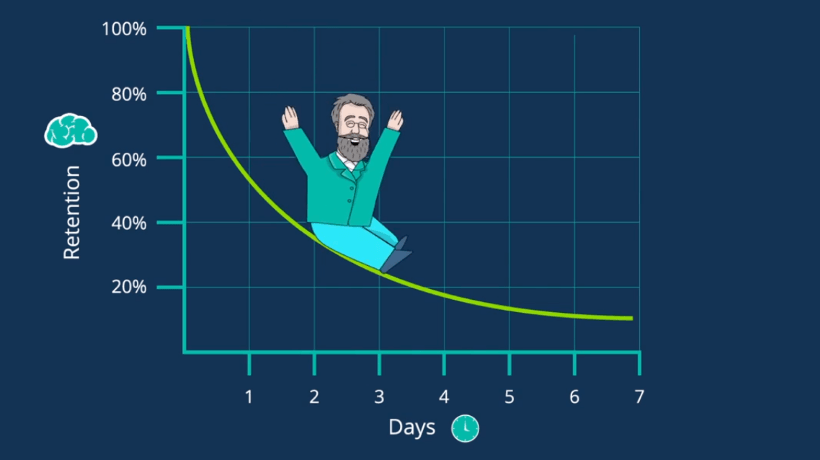
Active recall means testing yourself on what you just learned — not re-reading your notes, not highlighting, but actually trying to retrieve information from memory. Research by Roediger and Karpicke (2006) showed that students who tested themselves retained 56% of material after a week, compared to just 40% for those who only re-studied. The act of retrieval itself strengthens the memory.
The problem? Building your own review materials after every lecture is tedious and time-consuming. Most students know active recall works — they just don't do it because the friction is too high. That's why Amigo automatically generates a full suite of review tools from every lecture you upload:
- 📝 Study guides — structured summaries that break down key concepts
- ❓ Quizzes — adaptive practice questions that target your weak spots
- 🎧 Podcasts — audio reviews you can listen to on the go
- 🎬 Visualizations — animated concept explanations that make abstract ideas concrete
- 🃏 Flashcards — spaced repetition cards generated from your lecture content
Every student learns differently. Some need to read, some need to listen, some need to test themselves. Amigo gives you all of these from a single lecture upload — zero manual effort.
S — Spaced Repetition: Don't Let It Fade
Active recall after the lecture is critical, but one session isn't enough. Without follow-up, even tested material will eventually fade. Spaced repetition solves this by scheduling reviews at strategically increasing intervals — right before you're about to forget.
A meta-analysis by Cepeda et al. (2006) reviewed 254 studies and confirmed that spaced practice is overwhelmingly superior to cramming for long-term retention. The optimal review schedule isn't random — it's timed to catch memories just as they start to weaken, which makes each review more efficient than the last.
This is the compounding effect in action. Each review takes less effort and pushes the memory further into long-term storage. Over a few weeks, concepts that originally took 30 minutes to study need just a few minutes to reinforce. The knowledge becomes automatic.
💡 Why students procrastinate: Cramming feels like a rational strategy because it works in the short term — you can pass tomorrow's exam. But it's a losing game long-term. Every concept you cram and forget has to be relearned from scratch. Spaced repetition means you only learn things once and they stick.
Learning Is Compounding — Stop Letting It Reset
The reason most students feel like they're constantly behind isn't a lack of effort — it's a leaky bucket. They pour hours into studying, but without a system to retain what they learn, the bucket empties almost as fast as they fill it.
PEARS fixes the leaks. Each step reinforces the previous one: priming makes your lectures more effective, engagement captures the material while it's fresh, active recall cements it into memory, and spaced repetition keeps it there permanently.
When knowledge compounds, everything gets easier. New concepts build on old ones instead of replacing them. Exam prep becomes review, not relearning. The students who seem to "just get it" aren't smarter — they're retaining more of what they've already learned, so every new lecture adds to a growing foundation instead of starting from zero.
How Amigo Makes PEARS Effortless
The biggest obstacle to PEARS isn't understanding it — it's doing it consistently. Previewing lectures, recording and processing audio, building quizzes, scheduling reviews — that's a lot of overhead on top of an already busy student life. That's why we built Amigo to automate the entire PEARS cycle.
Prime — Instant Lecture Previews
Upload your lecture slides, recordings, or notes and Amigo instantly generates a summary and key concepts overview. Before you even walk into class, you have a clear picture of what's coming — your brain is primed and ready to absorb.
Engage — Smart Notes and Recording
Take notes in Amigo's editor with AI-powered autocomplete that pulls from your lecture materials as you type. Record your lectures directly in the app or upload them after class — our AI processes the full audio so you never miss a detail. Focus on thinking, not transcribing.
Active Recall — Every Review Format You Need
After every lecture, Amigo automatically generates study guides, adaptive quizzes, audio podcasts, animated visualizations, and flashcards — all from your lecture content. No manual creation, no guessing what to review. Every format adapts to your performance, focusing on concepts you're weakest on.
Spaced Repetition — Smart Review Scheduling
Amigo tracks your memory strength for every concept across every lecture and schedules reviews at the exact right moment. You never have to wonder "what should I study today?" — just open Amigo and it tells you. Over time, reviews get shorter and less frequent as your knowledge solidifies.
The result? You upload your lectures and Amigo runs the full PEARS cycle automatically. No more procrastinating because you don't know where to start. No more cramming because you forgot everything. Just a system that turns every lecture into knowledge that sticks.
Amigo Is Built for PEARS
From lecture recording to spaced repetition, Amigo.study is optimized for every step of the PEARS method
Try Amigo Free